
Choosing between a 20ft and a 40ft shipping container comes down to three things: how much you need to store, whether a delivery truck can reach your spot, and what you want to spend. A 40ft gives you roughly twice the floor space, but it needs more room to arrive and to sit. This guide compares the two, and the 40ft high cube, so you can pick the size that fits your property and your project.
Short answer: choose a 20ft if your site is tight, your load is modest or you want the lowest cost. Choose a 40ft if you need about double the floor space, long items or the best value per square foot, and your site can take the longer truck.
Quick comparison table
| 20ft standard | 40ft standard | 40ft high cube | |
|---|---|---|---|
| Outside (L x W x H) | 20 x 8 x 8.5 ft | 40 x 8 x 8.5 ft | 40 x 8 x 9.5 ft |
| Inside (L x W x H) | About 19.4 x 7.7 x 7.9 ft | About 39.4 x 7.7 x 7.9 ft | About 39.5 x 7.7 x 8.9 ft |
| Floor area | About 149 sq ft | About 303 sq ft | About 303 sq ft |
| Volume | About 1,170 cu ft | About 2,370 cu ft | About 2,700 cu ft |
| Door opening | About 7.7 x 7.5 ft | About 7.7 x 7.5 ft | About 7.7 x 8.5 ft |
| Empty weight | Roughly 4,850 to 5,070 lb | Roughly 8,300 to 8,800 lb | Roughly 8,700 lb |
| US pallets on the floor (48 x 40 in) | About 9 to 10 | About 20 to 21 | About 20 to 22 |
| Best for | Tight sites, tools, household and modest stock | Larger equipment, long items, bulk stock | Racking, tall items, workshops |
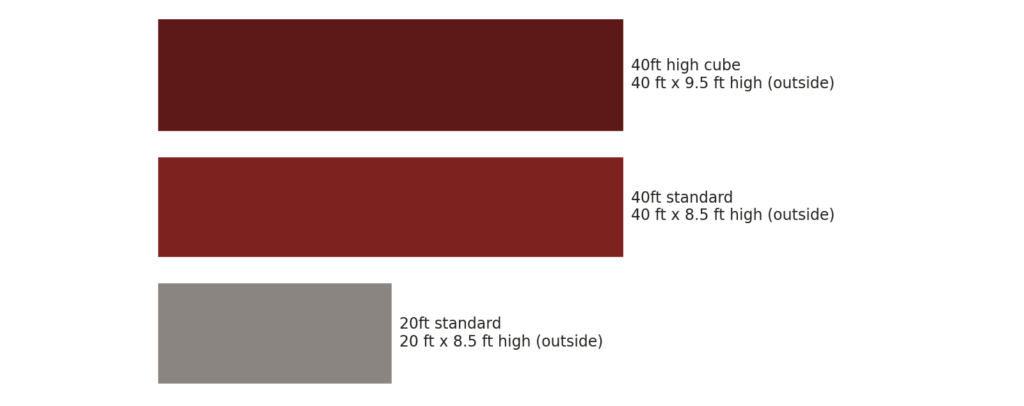
Outside size to scale (Side view)
Capacity and what fits
Floor space is the simplest measure. A 20ft has about 149 square feet and a 40ft about 303. In pallet terms, a 20ft holds roughly 9 to 10 standard US pallets laid out in one layer and a 40ft roughly 20 to 21.
- A 20ft usually suits lawn and garden equipment, tools, seasonal items, boxes and modest small-business stock.
- A 40ft usually suits larger or several pieces of equipment, long items such as fencing, pipe and lumber, bulk stock, and projects where you want to walk in and still have working room.
Measure the door opening, not just the inside. The door is about 7.7 feet wide and 7.5 feet high on both standard sizes, so a tall or wide item that fits inside can still fail at the door. The doors are at one end, so on a 40ft the back wall is nearly 40 feet from the door. Plan shelving along the walls and keep a clear path down the middle.
Think about how you will use the space as well as how much of it you need. A container you load once and rarely open can be packed tight. One you use every week needs aisle room, so a 20ft that looks big enough on paper can feel small once you leave space to walk and reach.
Delivery and site differences
Turning and pull-out
Most deliveries use a tilt-bed truck that backs into position and slides the container onto the ground. A 20ft typically needs about 70 to 80 feet of clear, straight access. A 40ft is longer, so it needs more room to approach, turn and pull out. Container Man’s published delivery requirement is an access area about 12 feet wide and 120 feet long, on ground that is dirt, grass, concrete, pavement or gravel, as long as it is not too soft.
Overhead clearance
Check overhead before you order. Container Man asks for about 14 feet of overhead clearance. A high cube stands a foot taller than a standard container, so wires and low branches matter more if you choose one. Walk the route from the road to the spot and look up.
A 40ft also needs a longer level area. On soft ground a container can settle unevenly, and a longer box spans more ground. Read how our delivery works.
Cost difference
A 40ft costs more than a 20ft, but not twice as much. Because it gives about twice the floor space, it usually costs less per square foot, so if you need the room it is generally the more economical way to get it. The gap tends to be wider for new containers than for used ones, and the exact difference depends on condition, grade and the yard the container ships from.
Two 20s or one 40?
Two 20ft containers mean two purchases and two deliveries, so they generally cost more than one 40ft for the same floor space. One 40ft is usually the cheaper way to get floor space. Two 20s still win in some cases: they fit a tight lot where a 40ft cannot turn, you can put them in different spots, and you can lock tools in one and stock in the other.
Delivery pricing varies by hauler. Some charge the same for any size, and others charge more for a 40ft because it needs a larger truck. Ask for delivered quotes on both sizes. For a quote from Container Man, request a quote.
When a 40ft high cube makes sense
A high cube is 9 feet 6 inches tall outside, a foot taller than a standard container, with about 8.9 feet of height inside and a door about 8.5 feet high. It holds roughly 10 to 13 percent more volume than a standard 40ft, and it usually costs only a little more, so the extra headroom is often good value for what it adds.
Choose a high cube for shelving and racking, tall equipment, a workshop where you want headroom, and items stacked high.
Skip it if overhead clearance on your delivery route is tight.
See our 40ft high cube containers.
Recommended size by use case
| Use | Suggested size | Why |
|---|---|---|
| Garage and household overflow | 20ft | Enough floor for most overflow and the easiest to place |
| Lawn, garden and hand tools | 20ft | Compact and easy to reach |
| Small-business stock | 20ft or 40ft | A 20ft holds about 9 to 10 pallets, a 40ft about 20 to 21 |
| Farm equipment and supplies | 40ft | Room for larger equipment and long items; check the door width |
| Contractor job site | 20ft, or 40ft for bigger projects | The 20ft is the most common job-site size |
| Workshop or tall items | 40ft high cube | Extra height and headroom |
| Tight lot or hard access | 20ft | Shorter truck and shorter approach |
Next steps
Still not sure? Send us your delivery ZIP code and a description of the spot, and we will help you choose. Browse 20ft containers or 40ft containers, or look at 40ft high cubes, then request a quote. You can also call 1 417-777-2391, Monday to Friday, 8 AM to 5 PM.